

Fostering Analytical Competence in Grade 2 Mathematics with Daily Practice
What if your best “calculator” student gets every answer right—but can’t explain why?
This action research explored whether daily structured maths practice could strengthen Grade 2 students’ analytical thinking and confidence, not just speed.
PROBLEM IN
CONTEXT
What the Data Revealed
At PWD Primary & Middle Campus, Grade 2 students were doing well in basic arithmetic, but the 2023 B-Meta results exposed a clear gap: many learners struggled when questions required analysis, reasoning, or problem-solving rather than direct calculation.
Why it Mattered
This weakness showed up in patterns, word problems, and “explain your thinking” tasks, where students often guessed or used rote methods without real understanding. Since analytical thinking is foundational for long-term maths success, the concern became a School Improvement Plan (SIP) priority, prompting teachers to investigate the issue through action research.
This challenge raised an important question for the teaching team: if students can calculate correctly, why do they struggle to justify their answers and solve unfamiliar problems? To explore this gap systematically, the teachers used action research to examine whether daily structured practice could strengthen students’ analytical competence—and whether that improvement would reflect in both assessment performance and mathematical confidence.
A performance target was established — 80% of Grade 2 students should achieve more than 70% marks in the B-Meta and Common Assessment Tasks (CATs) — emphasizing the importance of conceptual clarity and reasoning in mathematical learning.
Research Question
How can daily rigorous math practices enhance Grade 2 students’ analytical and problem-solving skills?
INTERVENTION TIMELINE AND ACTIVITIES
FINDINGS AND IMPLICATIONS
If you’re interested to learn more about the intervention, methodology, resources or the results, click on the button below to access the full research report.
Here’s the report podcast if you’re interested.
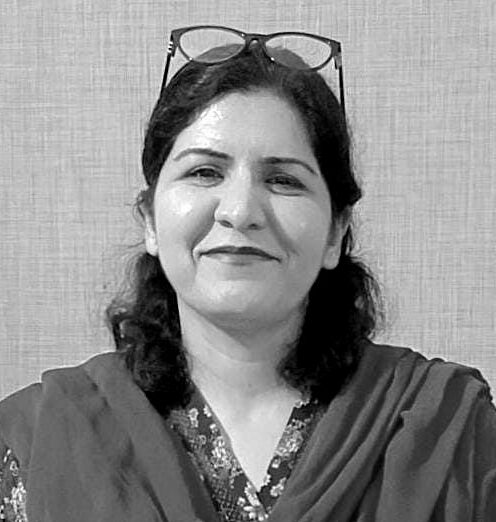
Saima Amjad Ali
School Coordinator
Saima Amjad Ali serves as a School Coordinator and teaches English to Grade 7 at Primary & Middle Branch PWD, Islamabad. In her leadership role, she strategically integrated the research initiative into the School Improvement Plan to advance academic excellence across the institution. The experience proved transformative, demonstrating how data-driven leadership can empower faculty members and foster a culture of continuous improvement. She strongly believes that research effectively bridges the gap between theory and practice, ensuring sustained growth in student learning and overall school performance.

Omaimah Farooqui
Instructional Coach
Omaimah Farooqui is an Instructional Coach and teaches General Science to Grade 7 at Primary & Middle Branch PWD, Islamabad. She engaged in action research with the objective of strengthening the analytical thinking skills of Grade 2 students. Through this process, she enhanced her reflective teaching practices and refined her use of targeted instructional strategies. She maintains that classroom-based research enables educators to make informed, evidence-based decisions that significantly improve student engagement, conceptual understanding, and academic achievement.